Dinosaurs went extinct around 65 million years around but roamed the earth for 165 million years. With new dinosaur fossils being discovered still to this day, there is always the question ”How did the dinosaurs walk?”. To determine how a dinosaur walks, footprints are needed which can become a difficult process.
Using the footprints, this can determine the locomotion for each different species of dinosaur, such as the smallest dinosaur ‘Compsognathus‘ to the biggest ‘Brachiosaurus‘ as either species would have different movements.
Fun Fact: The word dinosaur comes from the Greek language and means ‘terrible lizard’
Animal locomotion can come in many ways, such as; how an animal moves, where body weight it put in the movement, the body structure, and more. Dinosauria didn’t appear in literature in till 1842, before this time the name has not been mentioned.
Edward Hitchcock was the first person to study footprints in Connecticut Valley, which Hitchcock thought the footprints were from modern birds. Hitchcock’s friend, Richard Owen who also studied on footprints suggested that the footprints were actually from saurians. These fossils are now kept at Beneski Museum of Natural History of Amherst.
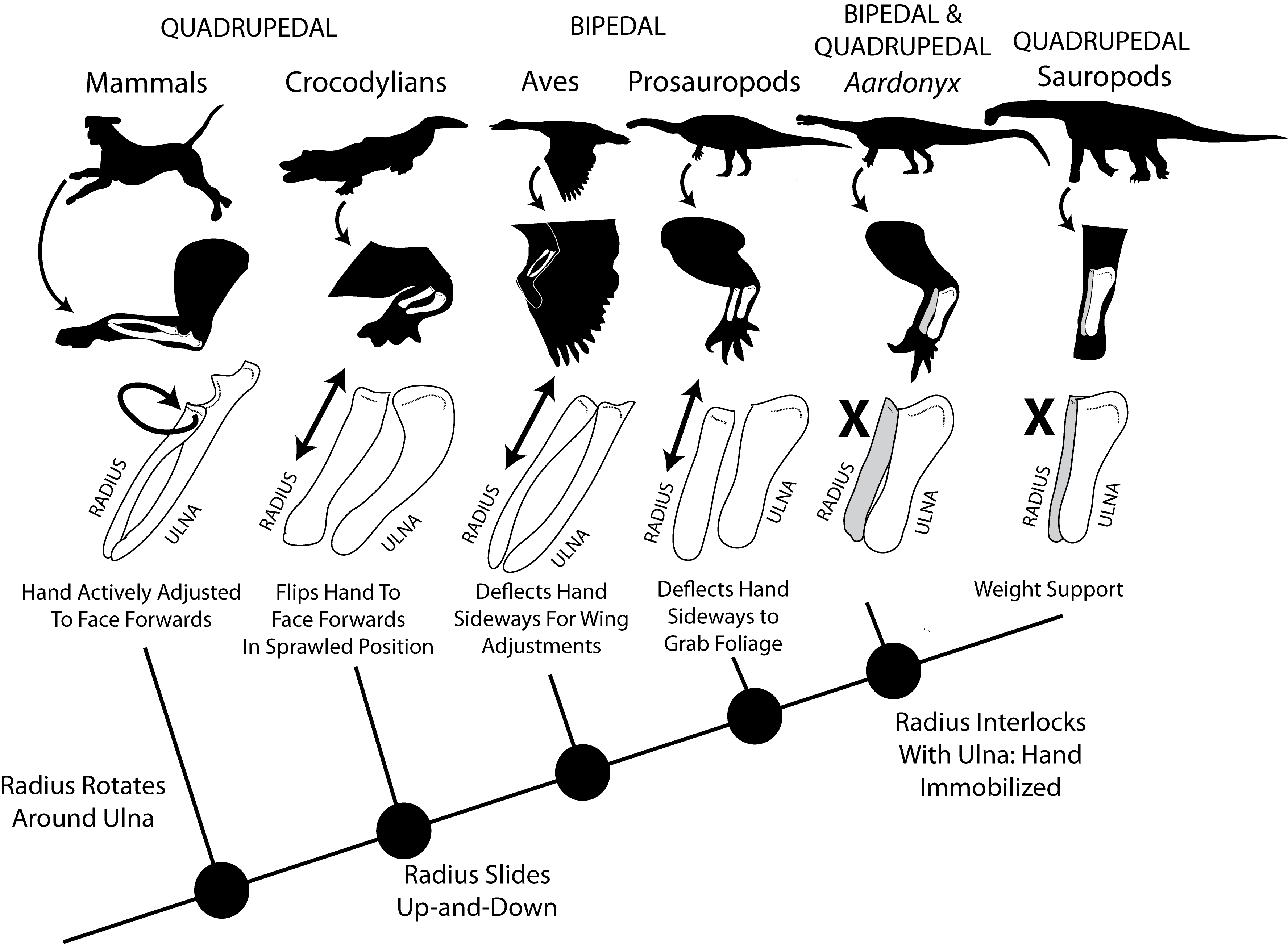
Evolution of the femur
About Peter Falkingham
Peter works on dinosaur footprints to determines the locomotion and compares them to current day birds, which are related to dinosaurs. Peter went to Liverpool John Moores University to work on this study but co-joins with Brown University and Peter’s master students.
About footprints
Footprints go into multiple layers on sediment, which can be formed in situ, vivo and records the motion, soft tissue anatomy and the environment itself. Substrate and anatomy will give tracks, adding dynamic into the equation will give the locomotion of the animal. Through evolution from dinosaurs to modern day birds, the femur gets shorter in length and also moves from behind the hip to in front of the hip.
- Dynamic = how did it move
- Anatomy = Bone, muscle, etc
- Substrate = Environment, wet, flat, etc
My Opinions
This talk was overall fascinating, this can help understand evolution more on the dinosaurs, while possibility understanding footprints on the current animals walking on earth now. This talk has helped my career as this can be done on reptiles, especially lizards as the lizards body shape come in many different variety of size, length, power, etc. Doing movement on reptiles would interesting me as a career as there’s so many different movements in each species.
Extra Reading
http://shapes.allanmccollum.net/allanmcnyc/reprints/Pdfs/Movement.pdf

 Herpetology with Emily Reed