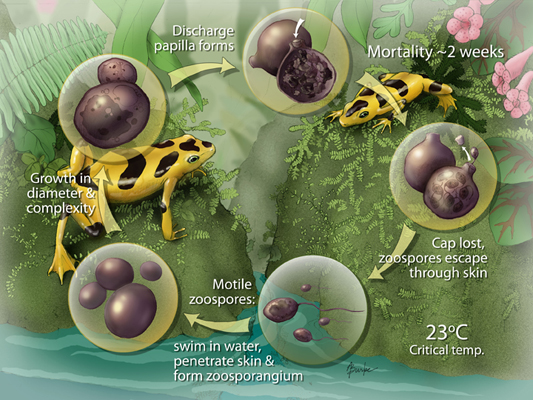
Chytrid fungus (Batrachochytrium dendrobatdis) only infects amphibians and is thought to be the main factor of amphibian decline or extinction across the world. Chytrid came come in two life stages; infective zoospores/sporangia, and life cycle of 4-5 days. It can affect all life stages, but tadpoles can only be carriers of the disease till the tadpoles metamorphose. The fungus has been found in 19 different places in the UK and was first reported in 2005.
Symptoms of Chytrid Fungus to look for;
- Large amounts of dead toadlets
- Skin flaking
- Lethargy
- Dead amphibians with no signs of cause of death or disease
- Froglets come out at May to June
- Newtlets come out at June to September
About the Common Toad and Alpine Newt
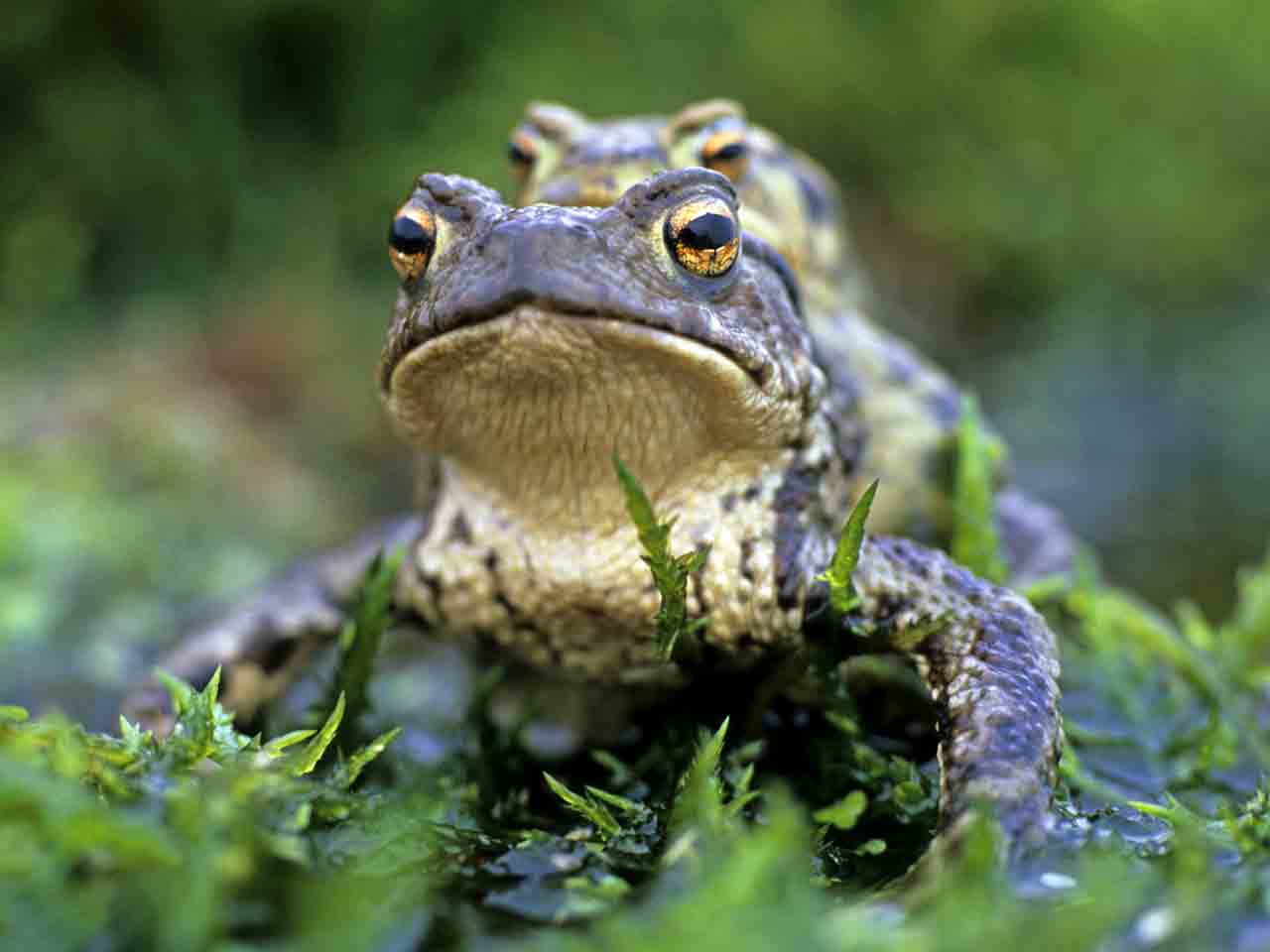
The common toad (Bufo bufo) is a native species in the United Kingdom but can also be found in most parts of Europe, the toad is not found in Ireland. B. bufo breeds in the spring which can live up to 10 years in the wild.
Alpine newt (Ichthyosaura alpestris) is native to central Europe but has been established in certain locations across Britain. I. alpestris also breeds in spring and can live up to 15 years in the wild.
The Study
David did the study in central Spain which was done on common toads (Bufo bufo) and alpine newt (Ichthyosaura alpestris). David came up with the theory that if a newt came out of water, this could kill the fungus as Chytrid is found in water.
He placed the newts in an environment with have terrestrial and aquatic, to which the next can chose where to go. He swabbed the newts once a week to keep an eye on the fungus. David did multiple experiments which had different levels of Chytrid fungus in each tank.
The newts would spend time in water in the beginning, after four days this would change, and the newts would be in the terrestrial environment when it got infected.
My Opinion
This study is overall very interesting, as there is no treatment for Chytrid but only prevention of this fungus. This could be a step forward to hopefully being closer to finding that treatment and stop the spread of this dangerous fungus. As it only infects amphibians, it is not in the line of field that I would go into but something that very interests me.
Extra reading
https://www.ncbi.nlm.nih.gov/pmc/articles/PMC3323396/
https://www.pnas.org/content/pnas/early/2010/04/30/0912886107.full.pdf
https://www.ncbi.nlm.nih.gov/pmc/articles/PMC3366739/
https://journals.plos.org/plosone/article?id=10.1371/journal.pone.0056802

 Herpetology with Emily Reed