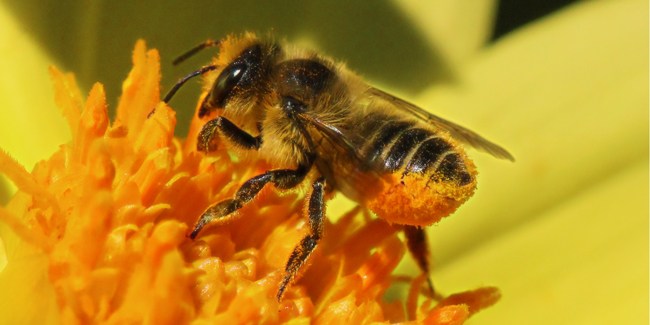
The honeybee (Apis) has seven species and forty-four subspecies, the most common honeybee is the Western honeybee (Apis mellifera) that has 26 recognised subspecies. Honeybees are partially endothermic, they can warm their bodies and the temperature in their hive by working their flight muscles.
They are also holometabolous insects, and have four stages in the life cycle: egg, larva, pupa, and adult. Apis have a parasite on them called the Varroa, which only grow up to 150mm wide with females being larger.
There are seven main different species of Apis:
- A. anoreniformis
- A. cerana
- A. dorsala
- A. filarea
- A. koschevnikovi
- A. nigrocincta
- A. mellifera


About Dylan Elen
Dylan is originally from Belgium but came over to Wales to do his PhD at Bangor University, but he is also the president of the beetrust over in Belgium. Dylan is also a bee keeper up in North Wales but does bee breeding projects. He has also done many projects on the bees, one being ‘Varroa resistance in North-West’.
About the Varroa parasite
The Varroa mite a external parasite that usually only feed on the haemolymph of adult honey bees as well as larvae and pupae. The mite can transfer viruses and bacteria to the bees, such as; Acute bee paralysis virus (ABPV), Deformed wing virus (BWV), and Slow paralysis virus (SPV). Varroa is a highly spread out parasite, but the only major honey producing country in the world which doesn’t have them is Australia
Finding out it a honeybee population has Varroa is easy and has many techniques such as; sugar shaking, alcohol wash, drone uncapping, and colony exam.
A heavy Varroa mite population can;
- Build up in 3/4 years
- Scattered brood
- Make bees cripple or crawling
- Impaired flight performance
- Lower rate of return to the hive
- Reduced life span
- Reduced weight of worker bees
My Opinions
There has been a lot of research on the honeybees; typically 80% of funding goes on the Western honeybee, 16% on the Eastern honeybee, then the last 4% on other species.
Bees overall are very interesting as they can use arrhenotokous parthenogenesis, which is when unfertilised eggs turn into males. With many more species to identify, research into them isn’t part of my interests. This could be an interesting project as parthenogenesis is done in reptiles and could see how each have evolved to be that way.
Extra Reading
http://194.47.52.113/janlars/partnerskapalnarp/ekonf/20130516/Haydak1970.pdf

 Herpetology with Emily Reed